Long before grocery stores stayed open late and delivery trucks arrived every morning, the kitchen pantry carried a quiet kind of responsibility.

It had to hold the ingredients that could feed a household through ordinary days and difficult seasons alike.
Farm families didn’t keep hundreds of products on their shelves. Instead, they relied on a handful of dependable foods that could be turned into dozens of meals. Those foods were inexpensive, filling, and adaptable. They were the ingredients that allowed a cook to stretch what she had and still put something warm on the table.
A well-kept pantry was never really about abundance.
It was about reliability.
Sometimes I think about the women who ran farm kitchens in the late 1800s and early 1900s. When they went to the store, their lists were short and practical — flour, sugar, coffee, salt, perhaps baking powder or yeast. Most of the rest of the food that filled their kitchens came from gardens, root cellars, smokehouses, and the pantry shelves they built slowly over time.
Today a trip to the grocery store often looks very different.
It isn’t unusual to push a cart down the aisle and come home with fifty items — sauces, boxed mixes, packaged snacks, frozen meals, and convenience foods designed to make cooking faster.
And yet when you step back and look closely, many of those products are still built from the same simple ingredients that once sat quietly on farmhouse pantry shelves.
Flour. Beans. Oats. Potatoes. Salt.
The difference is not so much the ingredients themselves, but how far they’ve been taken from the kitchen where they were once used.
Another thing worth considering is how much of modern food is no longer just the food itself.
When we buy a packaged product today, we’re often paying for more than the ingredients. There is factory processing, preservatives that allow foods to sit longer on shelves, stabilizers that help control texture, marketing, and the packaging itself — boxes, plastic trays, sealed tubes, printed labels, and the transportation needed to move all of it from factory to store.
All of that adds cost.
Sometimes the actual food inside the package is only part of what we are paying for.
When earlier generations bought ingredients, they were usually buying the food itself — a sack of flour, a bag of beans, a basket of potatoes. The cooking happened at home, and the pantry held the building blocks rather than the finished product.
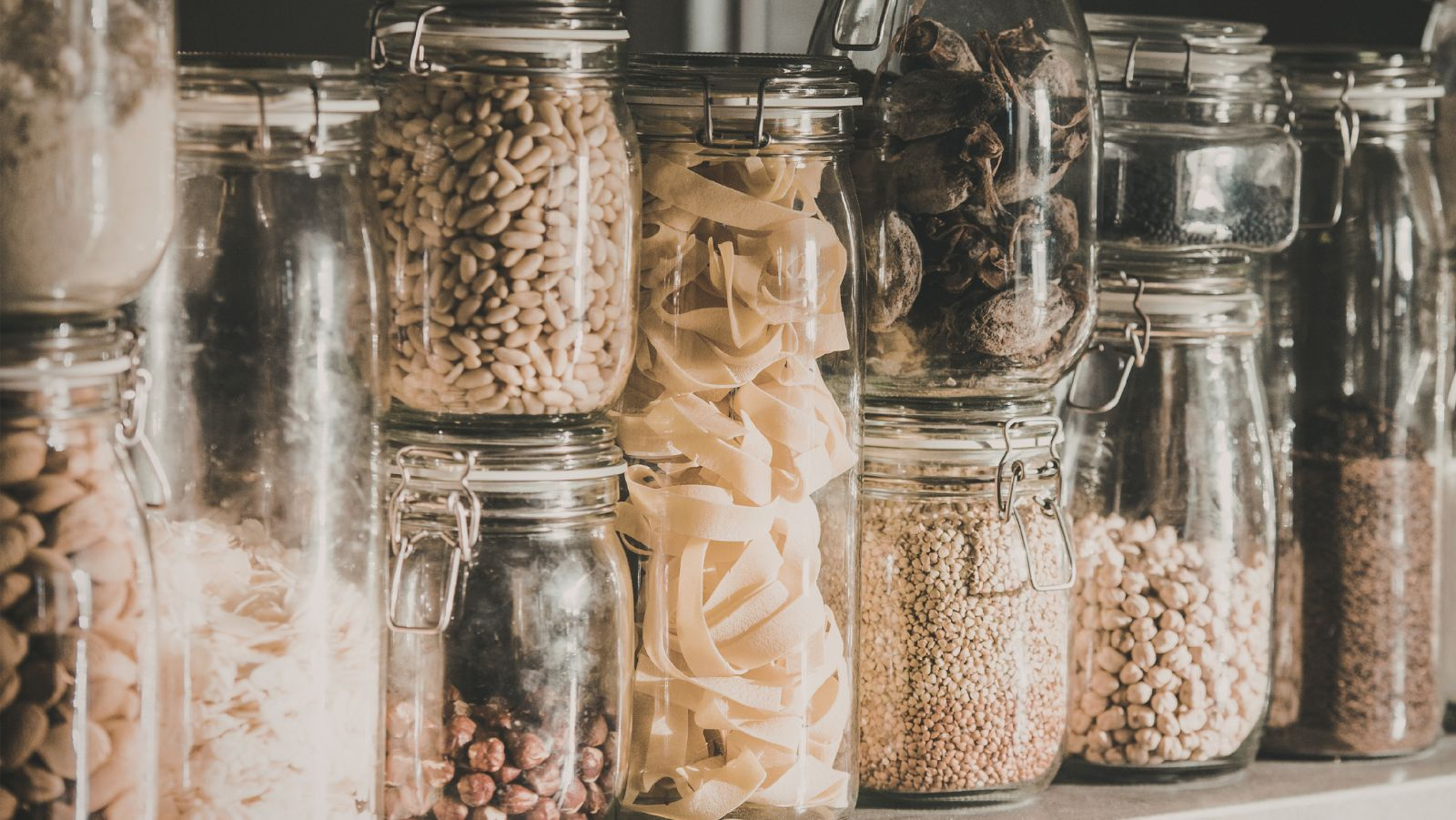
When I picture the farm kitchens that came before ours, I imagine shelves lined with crocks, sacks, and jars. Nothing fancy. Just the foods that made daily life work.
Here are five of the staples that built those kitchens.
Flour — The Foundation of the Kitchen

Few ingredients were as essential to a farmhouse kitchen as flour.
With flour you could make bread, biscuits, dumplings, pancakes, pie crust, noodles, and gravy. A single sack could stretch across dozens of meals.
For generations flour sat quietly in pantry bins because it was simply useful. Families relied on it because it turned simple ingredients into filling meals after long days of work.
In earlier times flour often came from local mills. Farmers hauled wheat to town and returned with sacks of freshly milled grain. The flour itself was often less processed than much of what we find today.
Modern food systems have changed many things about how grain is grown and processed, and many people today think more about where their flour comes from. Some choose organic flour, heritage grains, or flour from small mills, while others simply buy what is affordable and use it well in home cooking.
Either way, flour remains one of the most versatile foods a kitchen can keep on hand.
Few ingredients can turn simple pantry staples into so many satisfying meals.
Beans — The Quiet Workhorse of the Pantry

If flour was the backbone of a farm kitchen, beans were its quiet workhorse.
Beans have nourished households across the world for centuries because they are inexpensive, filling, and nourishing. They store well, cook easily, and stretch a meal farther than almost any other food.
A pot of beans simmering on the stove could become supper one night and the base for another meal the next day. Beans might appear in soups, stews, skillet meals, or simply served beside bread and vegetables.
In many farm households dried beans were purchased in large quantities and stored in jars or cloth sacks in the pantry.
They were dependable food — the kind that quietly kept a household fed without drawing much attention.
Even today, beans remain one of the most affordable and nourishing foods you can keep on your shelf.
Oats — The Original Breakfast Staple

Long before boxed cereals filled grocery store aisles, oats were the breakfast of countless farm families.
A warm pot of oatmeal simmering on the stove provided a simple, nourishing start to the day. Oats were inexpensive, easy to store, and filling enough to carry someone through a long morning of work.
But oats were never limited to breakfast alone.
They appeared in breads, cookies, and sometimes even savory dishes. In many kitchens oats were used to stretch other ingredients — mixed into meatloaf, added to soups, or baked into hearty breads.
Today oats remain one of the most economical pantry staples available. Many people also choose organic or minimally processed oats if they prefer.
However they are sourced, oats remain a reminder that some of the best foods are also the simplest.
Potatoes — The Humble Meal Builder

Few foods have sustained families through difficult seasons the way potatoes have.
Potatoes store well, grow in many climates, and can be cooked in countless ways. They can be baked, mashed, fried, roasted, added to soups, or turned into casseroles that feed a crowd.
In many farm kitchens potatoes were stored in cellars, baskets, or bins where they could last for months through the winter.
A basket of potatoes meant supper was never too far away.
Even when the pantry shelves looked a little sparse, potatoes could stretch a meal and make it satisfying.
Salt — The Ingredient That Preserved a Household

Salt may seem ordinary today, but historically it was incredibly valuable.
For centuries salt was essential for preserving meat, curing fish, fermenting vegetables, and seasoning nearly every meal that came out of a farmhouse kitchen.
Without salt, many of the preservation methods that kept households fed through winter simply would not have worked.
A small crock of salt near the stove was once as essential as the stove itself.
A Simple Example: The Biscuit

Sometimes the difference between a traditional pantry and a modern grocery cart becomes clear when you look at something simple, like biscuits.
A traditional biscuit recipe contains just a few ingredients: flour, fat, milk, baking powder, and salt.
Everything needed for biscuits was already sitting in the pantry.
But if you pick up a can of refrigerated biscuits at the grocery store and read the label, you’ll often find a much longer list — preservatives to extend shelf life, stabilizers to control texture, dough conditioners to help the biscuits rise evenly, and other additives designed to keep the dough stable while it sits in a refrigerated tube.
None of those things existed in the farm kitchens of the past.
Biscuits were simply mixed and baked fresh.
Convenience the Old-Fashioned Way

Earlier kitchens still found ways to make cooking easier.
If biscuits were made often — and in many homes they were — the dry ingredients were sometimes mixed ahead of time and kept ready in the pantry. Flour, baking powder, and salt might be stirred together in a jar or flour bin so that when biscuits were wanted, the measuring was already done.
Fresh biscuits could be mixed in just a few minutes.
Since it’s just the two of us here, I keep my biscuit mix in pint jars on the pantry shelf. A pint jar holds just enough for a small batch, which means no waste and no giant container taking up space.
I like tying a small paper tag to the jar with a bit of kitchen twine so I remember what’s inside. It’s simple, practical, and it makes the pantry look a little cheerful too.
Sometimes the old ways weren’t slower at all.
They were simply organized differently.
A Simple Biscuit Mix for the Pantry
For one pint jar:
1½ cups flour
1½ teaspoons baking powder
¾ teaspoon salt
Whisk the dry ingredients together and store them in a pint jar.
When biscuits sound good, pour the jar into a bowl.
Cut in 3 tablespoons butter or lard, then stir in ½–⅔ cup milk or buttermilk until a soft dough forms.
Pat the dough out, cut the biscuits, and bake at 425°F for about 12–15 minutes.
Fresh biscuits without opening a can.
A Small Note About the Mix
You can use any biscuit recipe you prefer.
The idea isn’t that this exact recipe must be followed, but simply that the dry ingredients can be mixed ahead of time and kept ready in the pantry.
Flour, baking powder, and salt store perfectly well together in a jar.
When it’s time to bake, you simply add the fresh ingredients — the butter or lard and the milk — according to the recipe you like best.
And just to be clear… the jar only holds the dry ingredients.
The butter, milk, and anything else your biscuits call for should be added fresh when you bake.
So no — we’re not storing cheese in the jar.
Sometimes a well-organized pantry is less about strict recipes and more about small habits that make everyday cooking a little easier.
The Quiet Wisdom of a Simple Pantry
Flour. Beans. Oats. Potatoes. Salt.
Nothing fancy.
And yet these ingredients fed families for generations.
A kitchen stocked with simple, dependable foods allows a household to cook nourishing meals without relying on expensive convenience products.
Sometimes the most reliable kitchen is still the one built on the simplest ingredients.